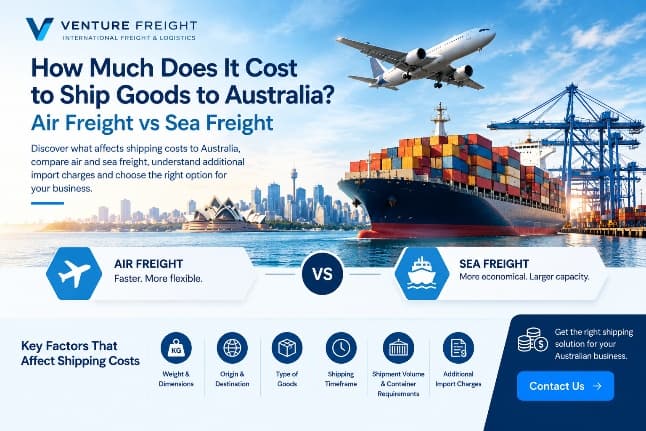
Shipping goods to Australia involves more than paying for transport from one country to another. Businesses importing products also need to consider shipment size, weight, origin, destination, customs clearance, insurance and other potential charges.
For some shipments, air freight is the most practical option because of its speed. For others, sea freight can provide a more economical solution, particularly when transporting large or heavy consignments.
So, how much does it cost to ship goods to Australia, and should you choose air freight or sea freight?
The answer depends on your shipment and business requirements. This guide explains the main cost factors, compares the two transport options and outlines how to plan your shipping budget.
1. What Determines the Cost of Shipping to Australia?
There is no single shipping price that applies to every international shipment. Freight rates depend on several variables.
Shipment Weight and Dimensions
Carriers consider shipment weight and, depending on the transport method and pricing arrangement, the space the shipment occupies.
For air freight, the chargeable weight is generally based on the greater of actual gross weight and volumetric weight, subject to the carrier's applicable rules.
Volumetric weight reflects the space a shipment takes up relative to its physical weight.
For sea freight, charges depend on factors including container type, shipment volume, weight restrictions and the applicable freight arrangement.
Practical example: A large consignment of lightweight packaging may occupy considerable space despite weighing relatively little. Its freight cost may therefore differ substantially from that of a compact, heavy shipment.
Country of Origin and Destination
Shipping costs vary according to where the goods are collected and delivered.
For example, the cost of shipping goods from China to Melbourne may differ from a shipment travelling from Europe to Perth.
Pricing can be influenced by:
- Distance and available transport routes.
- Departure and arrival ports or airports.
- Carrier capacity and service frequency.
- Origin collection and destination delivery.
- Terminal handling and local charges.
- Transhipment requirements.
Always compare quotes using the same origin, destination and delivery terms.
Type of Goods
The nature of the goods can affect freight charges and handling requirements.
Examples include:
- General commercial cargo.
- Fragile or high-value products.
- Oversized machinery.
- Temperature-sensitive goods.
- Dangerous goods.
- Products subject to special handling or regulatory controls.
Some products require additional packaging, specialised equipment, permits or documentation. These requirements may increase the overall shipping cost.
Shipping Timeframe
Urgent shipments can require faster or more expensive services.
If your business needs stock urgently to meet customer orders, air freight may be worth considering even when its transport cost is higher.
If the shipment can be planned well in advance, sea freight may offer a more economical alternative.
Shipment Volume and Container Requirements
For sea freight, the choice between full container load (FCL) and less than container load (LCL) can make a significant difference.
- FCL: Your cargo uses a dedicated container, subject to the agreed shipping arrangement.
- LCL: Your cargo shares container space with goods belonging to other shippers.
LCL may suit smaller shipments that do not justify booking an entire container. FCL may be suitable for larger consignments, depending on the cargo, pricing and handling requirements.
The best option depends on the total cost, volume, delivery schedule and any additional consolidation or destination charges.
2. Air Freight vs Sea Freight: Which Is Better?
Both methods have advantages. The right choice depends on your priorities rather than price alone.
| Factor | Air Freight | Sea Freight |
|---|---|---|
| Transit time | Generally faster | Generally slower |
| Typical use | Urgent, high-value or time-sensitive cargo | Larger shipments and less time-sensitive cargo |
| Pricing basis | Commonly chargeable weight | Container, volume, weight and shipment arrangement |
| Large consignments | Can become expensive | Often worth comparing for bulk cargo |
| Scheduling | Depends on airline capacity and routing | Depends on vessel schedules and port operations |
| Handling | Suitable for many packaged shipments | Suitable for a broad range of containerised and other cargo |
| Best decision factor | Speed and urgency | Total cost and shipment planning |
Actual transit times and prices vary by route, service availability, cargo type and operational conditions.
When Should You Choose Air Freight?
Air freight may be suitable when:
- Goods are urgently required.
- A delay could interrupt business operations.
- Products have a high value relative to their weight.
- The consignment is relatively small.
- You need to replenish inventory quickly.
For example, a business importing replacement components for essential equipment may prioritise delivery speed over the lowest possible freight charge.
However, air freight is not automatically the best option for every small shipment. Packaging, chargeable weight, customs requirements and final delivery costs should all be considered.
When Should You Choose Sea Freight?
Sea freight may be suitable when:
- You are importing large volumes of stock.
- Goods are heavy or bulky.
- Delivery dates can accommodate a longer transit period.
- You are shipping machinery, furniture or commercial inventory.
- You want to compare FCL and LCL options.
For example, a retailer importing a large consignment of products for the next sales season may prefer sea freight if the inventory can be ordered early enough.
Sea freight may offer lower transportation costs for many bulk shipments, but the total cost depends on the route, cargo, handling and destination charges.
3. What Additional Costs Should Importers Budget For?
One of the most common budgeting mistakes is comparing international freight rates without considering the other charges involved in getting goods to their final destination.
Your total landed cost may include the following.
Origin Charges
Depending on the shipping arrangement, these may include:
- Collection from the supplier.
- Export documentation.
- Origin terminal handling.
- Cargo consolidation or packing.
- Export clearance.
- Other origin-side service charges.
International Freight
This is the cost of transporting goods between the origin and destination.
It may be affected by fuel-related charges, carrier surcharges, routing, seasonal demand and the agreed service.
Destination Charges
Depending on the shipment, destination charges may include:
- Port or airport handling.
- Cargo deconsolidation for LCL shipments.
- Terminal or depot fees.
- Storage.
- Delivery from the port or airport.
- Other handling charges.
Customs Duty and GST
Australian importers may need to pay customs duty and GST, depending on the goods and circumstances of the importation.
Duty depends on factors such as tariff classification, customs value, origin and applicable concessions or trade agreements.
For taxable importations, GST is generally calculated using the applicable statutory rules, which may include the customs value, applicable duty, and international transport and insurance costs.
The actual calculation should be checked against current Australian requirements for the specific shipment.
Customs Brokerage and Documentation
You may also need to budget for:
- Customs broker fees.
- Import declaration services.
- Document preparation or review.
- Permits and certificates where required.
- Additional compliance-related services.
Insurance and Unexpected Charges
Cargo insurance may be worth considering to protect against covered loss or damage during transit.
Other potential costs include inspections, biosecurity treatment, demurrage, detention, storage and other charges arising from the circumstances of the shipment.
Not every shipment incurs every charge. Ask your freight provider to identify which costs are included in the quote and which are excluded.
4. What Is a Landed Cost?
The landed cost is the overall cost of getting imported goods to the relevant destination, including the applicable purchase, transport, import and handling costs.
For businesses, understanding landed cost is essential when calculating product margins and setting selling prices.
A simplified calculation is:
Landed cost = Product cost + International freight + Insurance + Applicable duty and taxes + Clearance and handling + Delivery
This is a planning framework rather than a universal tax calculation. The treatment of individual charges, recoverable taxes and other expenses depends on the circumstances.
Why Landed Cost Matters
Imagine that two suppliers offer the same product at similar prices.
One supplier has a lower product price but higher transport charges. Another has a slightly higher product price but a more economical shipping arrangement.
Comparing only the supplier's invoice could lead to the wrong decision.
A landed-cost comparison helps you evaluate the overall financial impact before placing the order.
5. How Can You Reduce Shipping Costs to Australia?
Businesses can take several practical steps to manage freight expenses without compromising essential service requirements.
Plan Shipments in Advance
Advance planning gives you more time to compare available services and reduces the likelihood of paying for urgent transport when it could have been avoided.
Compare Air Freight and Sea Freight
Do not assume one method is always cheaper for your particular consignment.
Compare quotes using the same cargo details, origin, destination, service scope and delivery requirements.
Optimise Packaging
Excessive packaging can increase shipment dimensions and, where volumetric pricing applies, freight costs.
Work with your supplier to use appropriate protective packaging without unnecessary bulk.
Compare FCL and LCL
For sea freight, compare the complete cost of FCL and LCL rather than looking only at the headline ocean freight rate.
Consider consolidation, destination handling, delivery and the shipment's volume.
Prepare Accurate Documents
Incorrect or incomplete documentation can cause avoidable corrections, delays and additional charges.
Ensure the commercial invoice, packing list, goods description and other relevant documents are accurate and consistent.
Understand Your Incoterms
The agreed Incoterms® rule determines important responsibilities and the allocation of certain costs and risks between the seller and buyer.
Confirm which party is responsible for transport, export formalities, import formalities and the relevant charges under the agreed rule.
Do not assume that a supplier's quoted price includes all costs required to deliver the goods to your premises.
Request a Detailed Quote
Ask your freight provider to clarify:
- What is included in the international freight rate?
- Are origin and destination charges included?
- Is customs brokerage included?
- Are duties and GST excluded?
- Is final delivery included?
- What additional charges could arise?
A detailed quotation makes it easier to compare options and budget accurately.
6. Shipping from China to Australia: What Should You Consider?
China is an important sourcing market for many Australian businesses. When planning shipments from China to Australia, consider the following:
Air freight: May suit urgent stock, samples, replacement parts and time-sensitive consignments.
Sea freight: May suit larger orders, bulky products, machinery and planned inventory replenishment.
Customs clearance: Check tariff classification, customs valuation, applicable duty, GST and the documentation required for your products.
Biosecurity: Some goods, packaging materials and products of plant or animal origin may be subject to Australian biosecurity requirements.
Final delivery: Confirm whether the quotation includes collection from the supplier, international transport, customs clearance, destination handling and delivery to your business.
Your best shipping option will depend on the product, dimensions, origin, destination, required arrival date and total landed cost.
7. How Venture Freight Can Help
Choosing a freight method is only one part of managing an international shipment. Businesses also need to coordinate documentation, customs requirements, handling and final delivery.
Venture Freight provides freight and logistics services to help businesses plan and coordinate international shipments.
Depending on your requirements, our team can discuss:
- Air and sea freight options.
- International freight forwarding.
- Customs brokerage coordination.
- Trade-documentation consultation.
- Door-to-door transportation.
- Warehousing and related logistics requirements.
We can help you understand the factors affecting your shipment and identify the information needed to assess suitable freight options.
Request a Shipping Quote
Every shipment is different. To help assess your requirements, prepare the following details:
- Origin and destination.
- Description of the goods.
- Number of packages.
- Dimensions and gross weight.
- Whether the shipment is urgent.
- Any special handling or regulatory requirements.
Planning your next shipment to Australia?
Contact Venture Freight to discuss your cargo, compare available shipping options and request a quote tailored to your requirements.
Request a quote from Venture Freight to discuss international freight and logistics for your next shipment.
Final Thoughts
The cheapest freight rate is not always the most economical shipping solution.
Businesses importing goods into Australia should compare air and sea freight, understand their landed costs, prepare accurate documents and account for destination charges before choosing a transport method.
With appropriate planning and a clear quotation, you can make better-informed shipping decisions and manage your import budget more effectively.
Venture Freight can help you explore international freight and related logistics options for your next shipment.
Related service
Worldwide Air & Sea Freight →